Sons of Liberty Gun Works Combat V2 13.7" Review: A Surprisingly Solid Budget-Friendly Performer
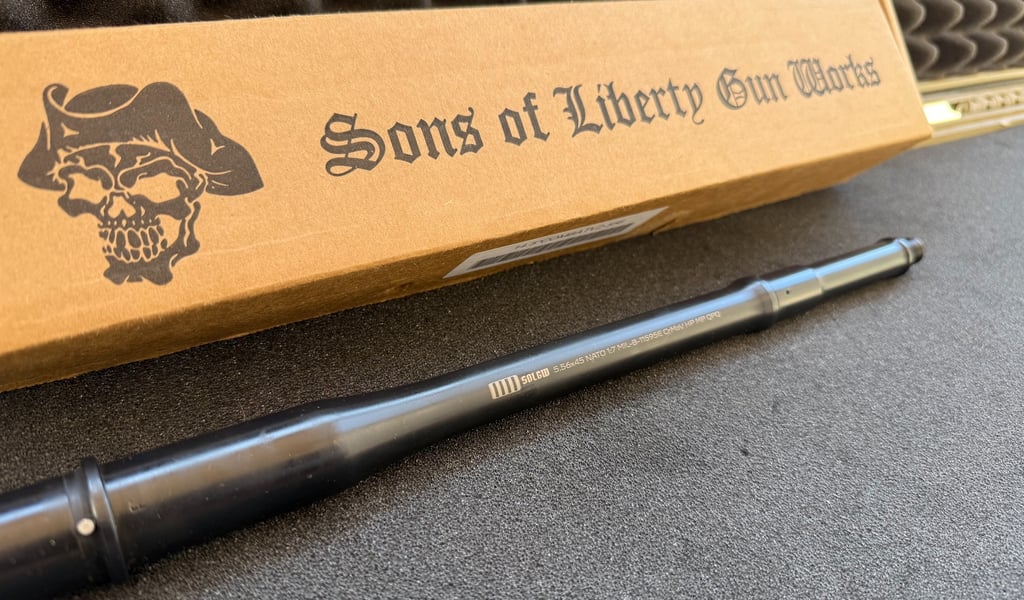
The Sons of Liberty Gun Works Combat V2 13.7" button rifled barrel delivered good overall performance for the price, with respectable precision, and generally good build quality for a relatively inexpensive general-purpose AR-15 barrel.
Bottom Line
The SOLGW Combat V2 13.7" barrel ended up being a pretty solid performer overall, especially considering the price point these were selling at before being discontinued. It’s not a precision-focused barrel, but it still produced respectable results with match ammunition and compares favorably against many other barrels in this general price range.
The barrel also has a contour that keeps more weight toward the rear, which helps keep the rifle feeling relatively maneuverable and balanced despite being more of a mid-weight profile.
Unfortunately, the button rifled Combat V2 barrels appear to have been discontinued and replaced by SOLGW’s newer Liberty Fighting Barrel lineup, although there are still a few retailers with remaining inventory available at the time of writing.
Pros & Cons
Pros
Good overall performance for the price
Respectable precision with match ammunition
Good dimensional consistency and fitment
Rear-weight-biased contour keeps the rifle maneuverable
Compares favorably against similarly priced offerings
Cons
Discontinued by manufacturer
Remaining inventory appears limited
Not a true precision-oriented barrel
Some machining marks visible under borescope inspection
Price & Availability
When these barrels were still widely available, they were priced similarly to offerings from companies like Ballistic Advantage, Faxon Firearms, and Rosco Manufacturing.
I think the Combat V2 offered pretty good value overall. The barrel isn’t trying to compete with high-end precision stainless barrels, but for a general-purpose nitride-treated 4150 CMV barrel, the performance was solid.
Who Is This Barrel For?
Best Use Cases
General-purpose carbines
Lightweight-to-midweight practical rifles
Duty/training style setups
Shooters wanting decent precision without spending premium-barrel money
Rifles that will be shot more from unsupported positions where handling matters
The rear-biased contour helps keep the rifle feeling relatively agile compared to some front-heavy profiles, which I think makes this barrel more appealing for practical shooting applications rather than bench-focused precision shooting.
Less Ideal For
Dedicated precision rifles
Maximum long-range consistency
Shooters chasing the smallest possible groups
Heavy sustained-fire applications
Group Performance
Test Protocol
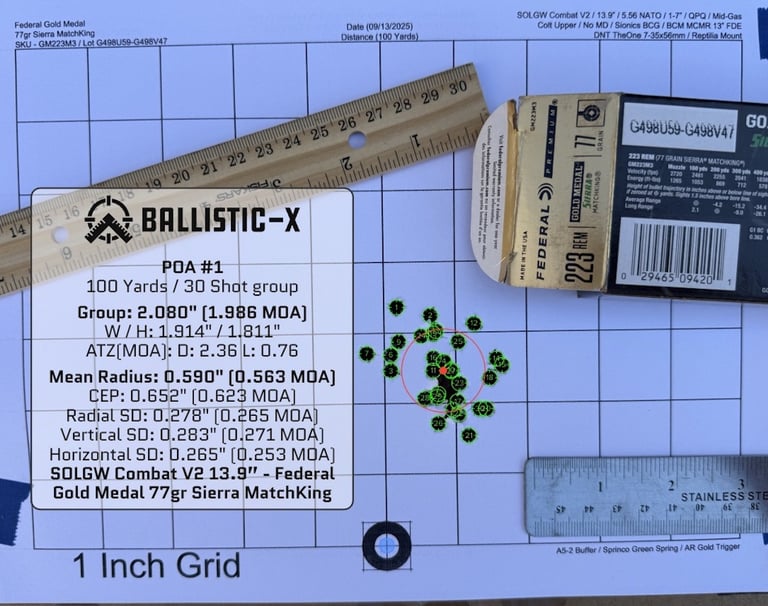
All groups were fired at 100 yards using 30-shot groups.
The rifle was stabilized with a front rest and rear bag, and the barrel was cooled between groups using a leaf blower and chamber chiller. Velocities were recorded using a Garmin chronograph, while a Mantis X and Shooter’s Global SG Pulse were used to monitor shooter-induced movement.
As always, these results reflect this specific barrel with this specific ammunition selection. Performance can vary between individual examples.
Federal Gold Medal Match 77gr SMK
Velocity
Average Velocity: 2328 fps
Standard Deviation: 17 fps
Extreme Spread: 76 fps
Accuracy
30-Shot Group Size: 1.986 MOA
Average 10-Shot Group Size: 1.4 MOA
Mean Radius: 0.563 MOA
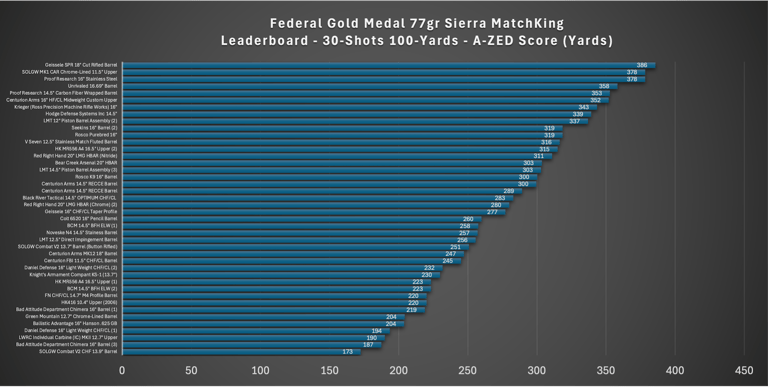
A-ZED Score: 251 yards
This ended up being a pretty respectable group overall and was noticeably better than the 13.9" CHF Combat V2 barrel I previously tested.
The cold bore shot landed slightly high-left, but the remainder of the group clustered together fairly well overall.
Out of 42 Federal Gold Medal groups I’ve shot so far, this barrel landed roughly in the middle of the leaderboard.
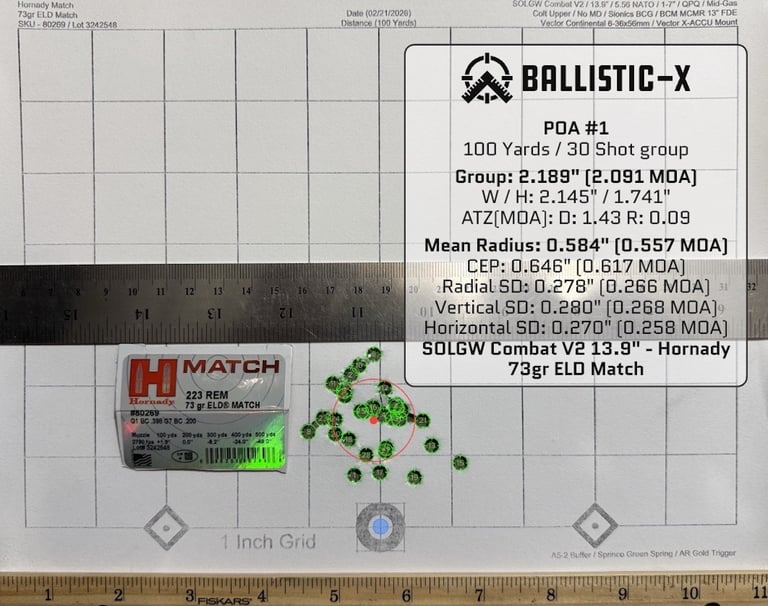
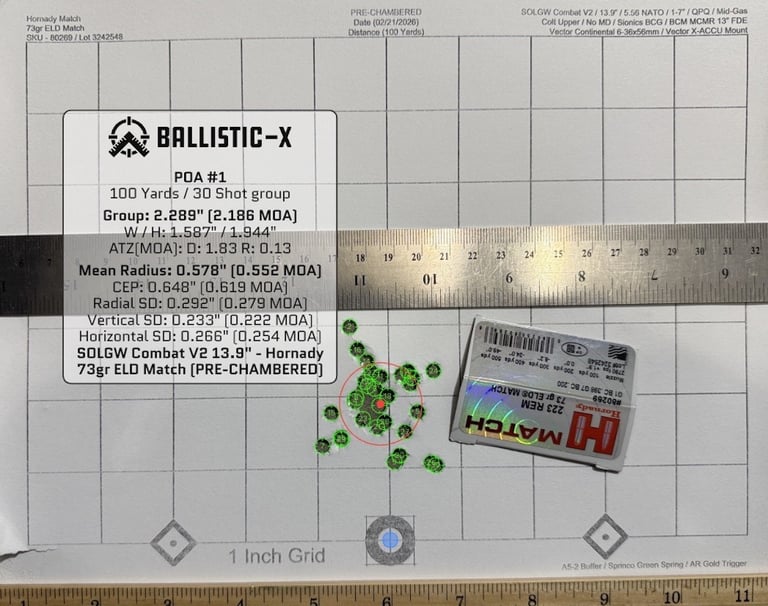
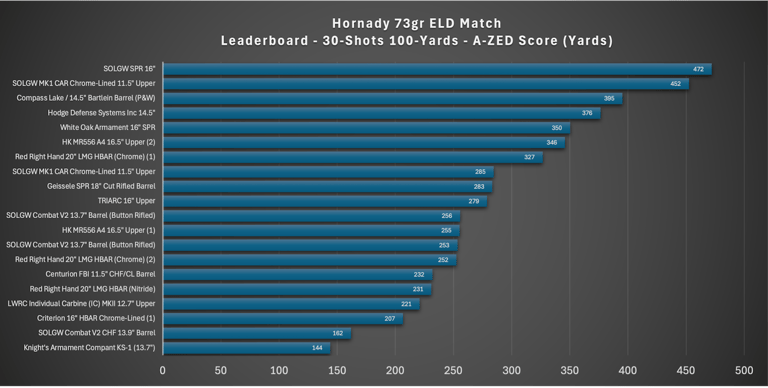
Hornady 73gr ELD Match
For this portion of the testing, I shot two groups:
One normal group
One group where every round was manually chambered and ejected prior to firing
The purpose was to see whether repeatedly chambering rounds would measurably affect performance or seating depth consistency.
Velocity
Standard Group
Average Velocity: 2422 fps
Standard Deviation: 23 fps
Extreme Spread: 87 fps
Pre-Chambered Group
Average Velocity: 2412 fps
Standard Deviation: 29 fps
Extreme Spread: 121 fps
Accuracy
Standard Group
30-Shot Group Size: 2.091 MOA
Average 10-Shot Group Size: 1.7 MOA
Mean Radius: 0.557 MOA
A-ZED Score: 253 yards
Pre-Chambered Group
29-Shot Group Size: 2.186 MOA
Average 10-Shot Group Size: 1.7 MOA
Mean Radius: 0.552 MOA
A-ZED Score: 256 yards
Interestingly, there really wasn’t much meaningful difference between the two groups. Roughly 70% of the rounds showed no measurable change in CBTO or headspace after chambering, and most of the remaining rounds only changed by around one or two thousandths.
Overall, the results ended up being remarkably similar.
IMI Razor Core 77gr HPBT
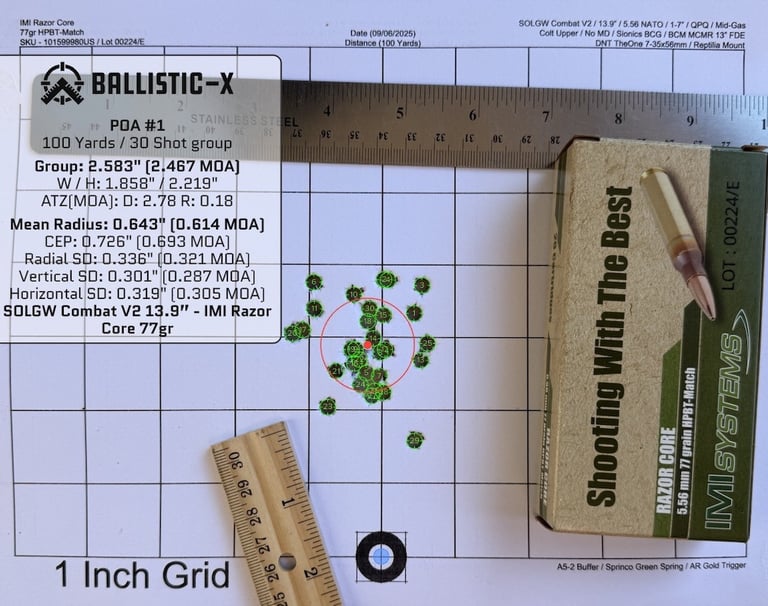
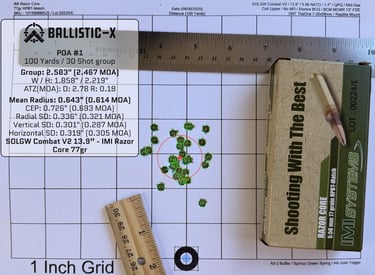
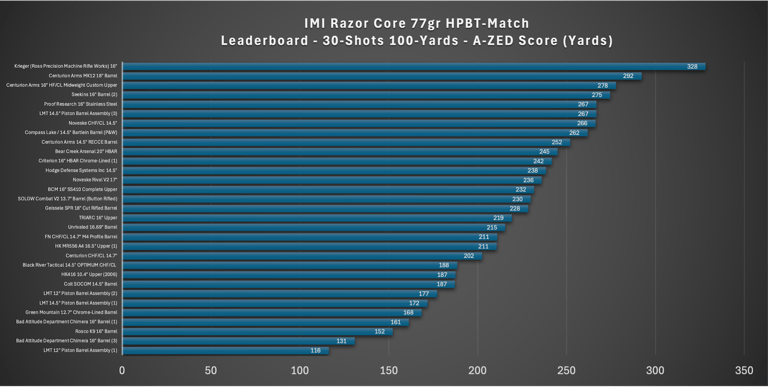
I also shot IMI Razor Core 77gr through this barrel, which actually ended up producing some fairly respectable results. This group ended up placing 15th out of 31 groups on the leaderboard for IMI Razor Core
Average Velocity: 2583 fps
Standard Deviation: 24 fps
30-Shot Group Size: 2.467 MOA
Average 10-Shot Group Size: 1.7 MOA
A-ZED Score: 230 yards
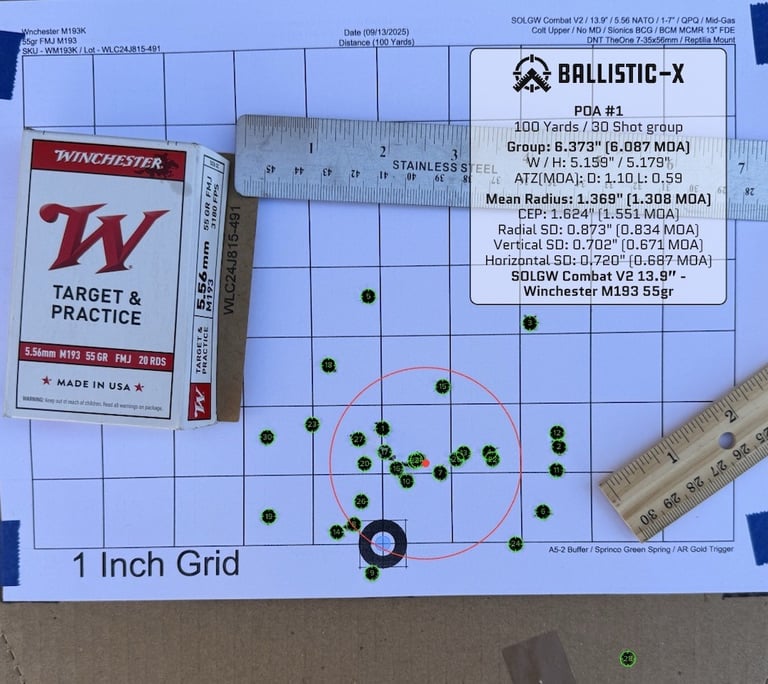
Winchester M193 55gr FMJ
Velocity
Average Velocity: 2973 fps
Standard Deviation: 24 fps
Extreme Spread: 102 fps
Accuracy
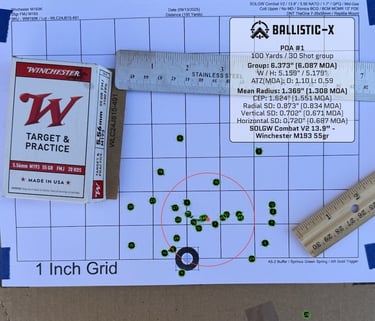
30-Shot Group Size: 6.087 MOA
Average 10-Shot Group Size: 4.6 MOA
Mean Radius: 1.308 MOA
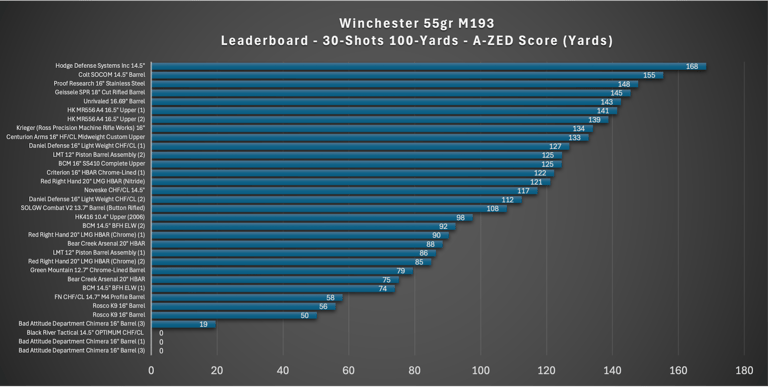
A-ZED Score: 108 yards
This group was… not great. To be fair, this is also fairly consistent with my broader experience with Winchester M193 across multiple barrels.
Core Specs
Specifications
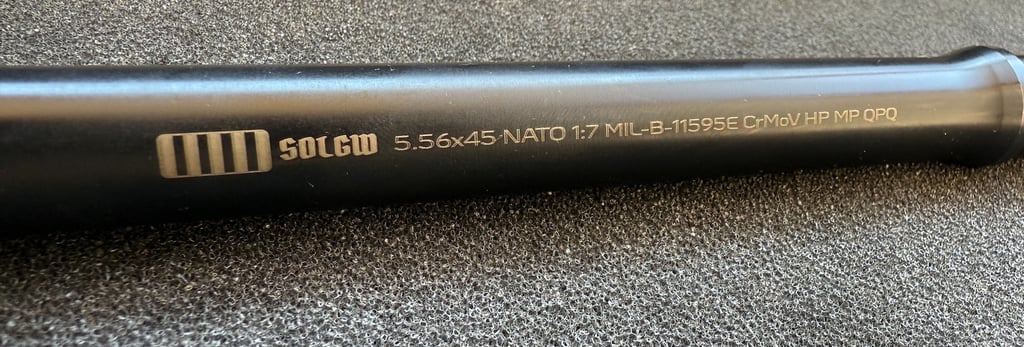
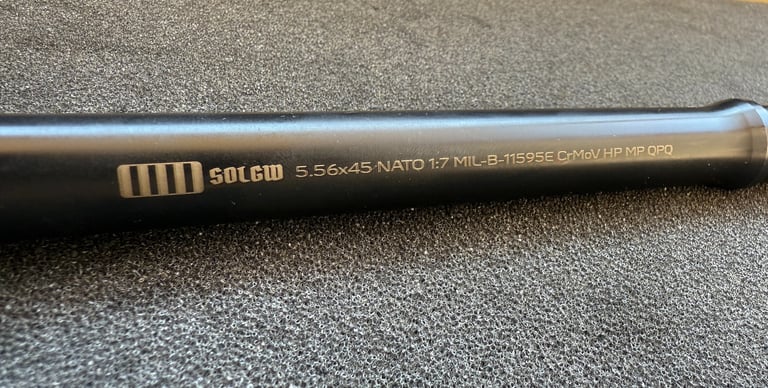
Length: 13.7"
Chamber: 5.56 NATO
Twist Rate: 1:7
Gas System: Mid-Length
Material: 4150 CMV Steel
Bore Treatment: QPQ Nitride
Exterior Finish: QPQ Nitride
Rifling Method: Button Rifled
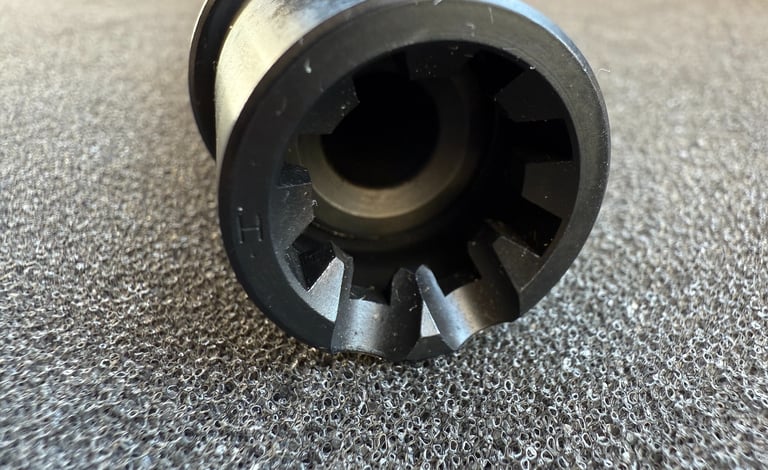
Muzzle Threads: 1/2x28
Gas Block Dimple: Yes
The overall configuration is pretty conventional aside from the somewhat less common 13.7" length. Other than that, this is essentially a modern general-purpose AR-15 barrel configuration geared toward practical use, reliability, and decent all-around performance rather than absolute precision.
Inspection & Measurements
Dimensional Measurements
Weight: 1.63 pounds
Gas Port Diameter: 0.078"
Gas Block Journal Diameter: 0.7498"
Barrel Extension Diameter: 0.9998"
Throat Erosion Gauge: 1
Chamber Dimensions: Passed
Headspace: Less than 0.002" over minimum spec
One thing that stood out during inspection was that both the barrel extension diameter and gas block journal diameter measured slightly larger than average. In practice, that resulted in a tighter-than-average fit with both the upper receiver and gas block.
The headspace also ended up being fairly tight compared to many production AR-15 barrels, which I generally like to see on a new barrel.
The 0.078" gas port also felt pretty reasonable for a 13.7" mid-length setup. During live fire, recoil impulse and ejection behavior felt pretty normal overall.
Borescope Inspection
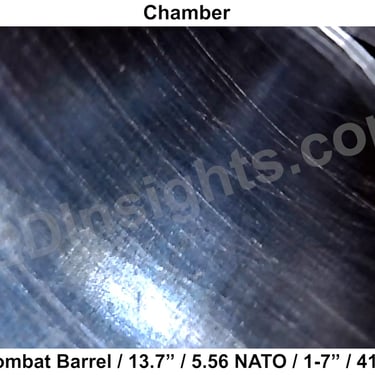
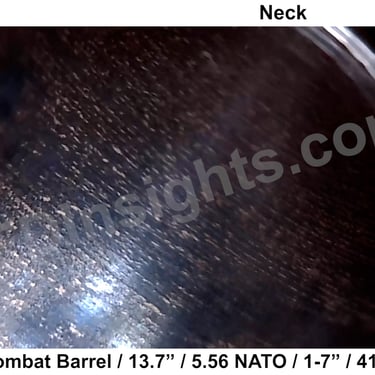
Chamber
The chamber looked generally fine overall. There were a few light scratches visible, but nothing that concerned me.
The neck area also had a bit of visible texture, although it didn’t appear to leave any meaningful impressions on the fired brass.
Throat
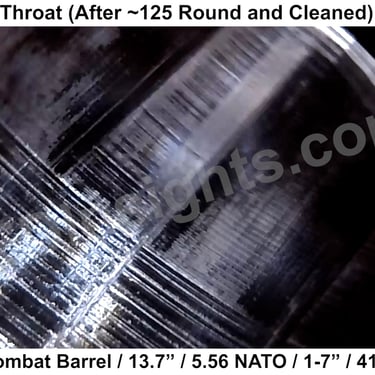
The throat area showed a noticeable amount of machining marks once the barrel had been fired and cleaned. The start of the rifling itself looked fairly even, which was good to see, but there were still visible tool marks in the freebore and lead area.
The machining marks weren’t catastrophic by any means, but they also weren’t particularly impressive.
That said, the barrel still shot reasonably well despite them.
Rifling
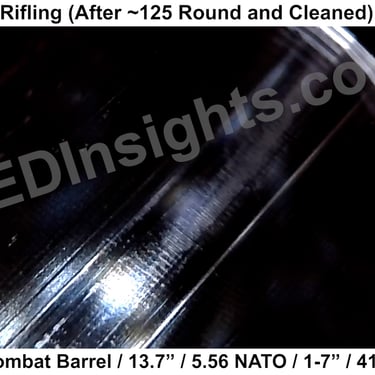
The rifling also showed some visible tooling marks after firing and cleaning, although nothing especially unusual for a nitrided AR-15 barrel in this price range.
Gas Port
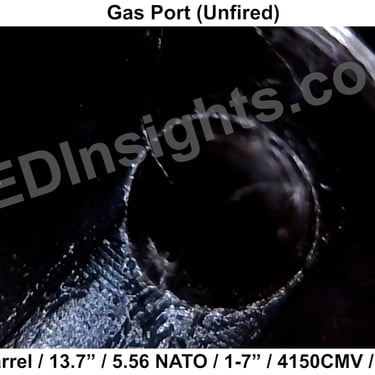
The gas port had a small burr visible around the edge before firing, but again, nothing outside of what I would consider pretty normal for a production AR barrel.
Crown
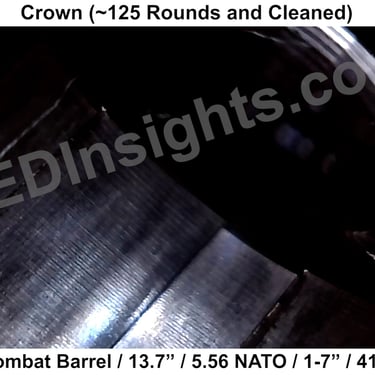
The crown looked good overall. The leading edge appeared clean without any obvious rough spots or damage.
Overall, the borescope findings looked appropriate for the price point. Not perfect, but also not concerning.
Overall Thoughts
Overall, I think the SOLGW Combat V2 13.7" button rifled barrel performed pretty well for what it is.
It’s not a precision barrel, and the borescope certainly showed some compromises in machining quality compared to higher-end options. But at roughly a $200 price point, the actual on-target performance ended up being pretty respectable.
The dimensional consistency and fitment also ended up being better than I expected for a barrel in this category.
If you’re looking for an inexpensive general-purpose barrel that still delivers decent practical precision, I think the Combat V2 compares fairly well against many of its peers.
Disclosure
This barrel was donated to the channel in brand new condition by a subscriber.
I paid for all ammunition used in testing.
Some links in this article may be affiliate links from which I earn a commission.
© 2026. All rights reserved.